
Polished steel fails for three reasons, and heavy use is not one of them. Chlorides from a hand, water held in the air around the metal, and the box it is put away in will mark an instrument long before a busy clinic wears it out. Conservators describe the same three agents when they write about centuries-old blades, and the care section of a register of European swords sets the vocabulary out entry by entry: what a fingerprint etches into a surface, what humidity does over a decade, and what the wrong case releases into the air around the steel.
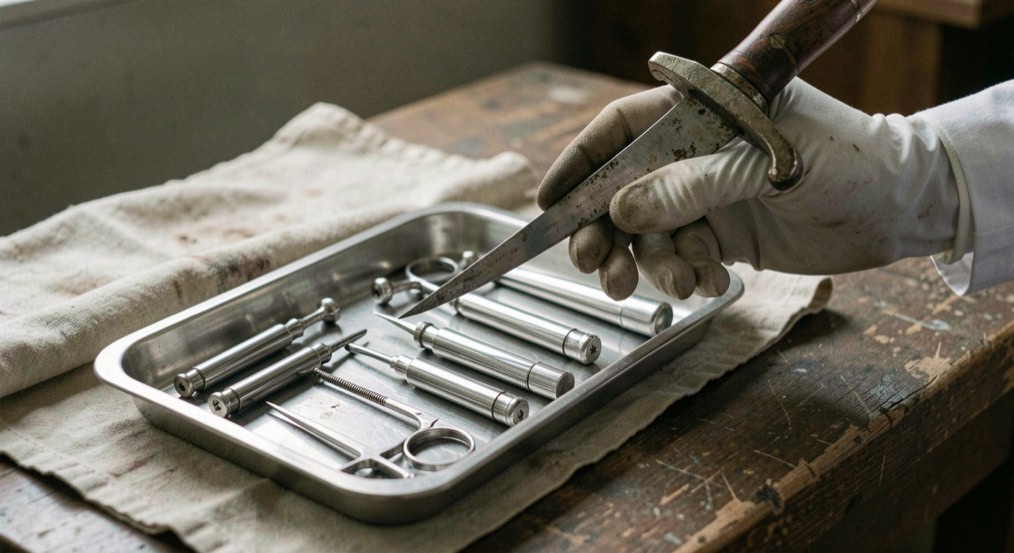
Why a lid speculum and an old blade corrode the same way
Rust is not a property of age. It is a reaction that needs iron, oxygen and water, and it starts wherever the passive layer on the surface has been interrupted. In an eye clinic the interruption is ordinary: a wipe with a cloth that was not dry, a tray that was stacked while still damp, a case lined with a material nobody thought about. The instrument does not need to be used to deteriorate. It needs only to be stored somewhere the relative humidity stays high.
This is why the useful reading for anyone keeping instruments for a working lifetime comes from the museum side rather than the catalogue side. Curators work with objects they intend to keep for a century, and their advice is written around the object rather than around a sales cycle. It is also, in practice, cheaper to follow than replacing instruments.
Fingerprints: the mark that etches itself
A fingerprint on bare steel carries chlorides from the skin, and chlorides break down the oxide layer that protects the surface. The mark does not sit on the metal; it works into it. On a mirror-polished surface the result is permanent, and in a warm room it appears within days rather than months. On a satin-finished instrument the damage is slower and easier to miss, which is why trays that look clean can still carry a map of every hand that has handled them.
The practical rule is short. Nitrile gloves, or hands washed and thoroughly dried, and no hand cream on the day. Cotton gloves are the museum tradition, and they are a poor choice for heavy or sharply tapered steel because they slip. The instruments I use for indirect ophthalmoscopy and the small speculums that go with them are picked up by the handle and never by the working surface, and they are wiped dry with a clean cloth before they go back in the case, because a hand has always touched them somewhere.
Where chlorides have already entered the metal, for example on excavated iron, they sit inside the corrosion layers and restart the reaction whenever the humidity rises. That is the mechanism behind the bright orange weeping spots collectors recognise on old material, and it is why a conservator treats the object rather than the surface.
Humidity, stability and the case you choose
Water is the factor that decides the outcome. Corrosion of iron needs moisture, and below a certain relative humidity it effectively stops. Two consequences follow for anyone storing instruments or documents. The first is that the level matters. The second, and the one that is usually forgotten, is that stability matters as much as the level: repeated cycling between dry and damp puts more stress on a surface than a constant figure that is slightly higher than ideal.
The case itself is an agent. Oak and several other timbers release acetic acid vapour, as do some adhesives, paints and plastics, so a blade or an instrument sealed into a handsome wooden box can sit in a small acid chamber. Wool, some felts and some rubbers release sulphur compounds that tarnish silver inlay and attack copper alloy fittings. Leather holds moisture against the metal and carries residual tanning acids, which is why a blade kept in its scabbard for a decade comes out marked with the shape of the liner. A padded, chemically inert surface in a stable room is a better home than a fitted case with a decorative lining.
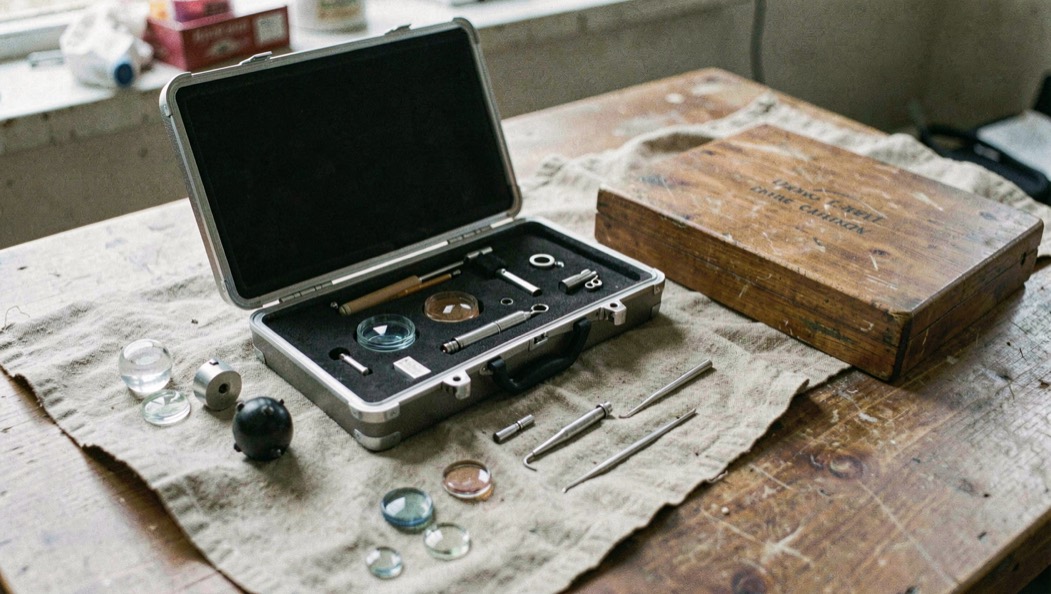
What museum practice adds to a clinic routine
Preventive conservation starts with a short list. The ten agents of deterioration published by the Canadian Conservation Institute cover physical forces, pests, pollutants, light, incorrect temperature and incorrect relative humidity, and they are written so that a non-specialist can act on them. Reading that list once changes how a practice stores things, because most of the entries cost nothing to address.
Three habits transfer directly. Support long metal objects along their length with both hands rather than lifting them by the tip or by a joint. Put them down on a padded, chemically inert surface rather than on a bare table, and never on newsprint. And treat a change in the surface as information: bright orange, powdery and slightly damp means active corrosion, which is a reason to stop, isolate the object and ask someone who works with the material.
For the clinical side of the examination itself, the sequence and the findings are covered in the guide to ophthalmoscopy technique and what the examination records, and the owner-facing version of the same appointment is set out in what happens during an eye examination. Neither the technique nor the certificate outlasts the instrument it depends on.
The vocabulary that prevents mistakes
Half of the confusion around old metal comes from using one word for several different materials. A short glossary removes most of it. Austenite is the structure plain carbon steel takes above its critical temperature, and every hardening operation depends on reaching it. A bloom is the spongy mass of iron and slag drawn from a bloomery furnace, which has to be consolidated by forging before it can be used. Crucible steel was melted in a sealed pot and cast as an ingot with roughly one to two per cent carbon. Distal taper describes the reduction in thickness from the hilt to the point, and edge geometry describes the shape of the cutting bevel, convex and durable or flat and keener. None of these terms is decorative; each one predicts how a piece behaves when it is handled.
The register collects forty-six of them, covering the parts of a blade and hilt, the fittings of a scabbard, and the metallurgical vocabulary that catalogue entries assume the reader already knows. A practice that adopts the same discipline for its own instruments, naming the alloy, the finish and the storage conditions, ends up with fewer unexplained marks and a maintenance record that can be handed on.
Where the surviving steel can be seen
The argument for looking at real objects is the same in veterinary ophthalmology as in arms and armour: photographs flatten proportion, and a surface seen under gallery lighting tells you more about finish than any description. Public collections in Europe with substantial holdings include the Wallace Collection in London, the Royal Armouries in Leeds, the Hofjagd- und Rüstkammer in Vienna, the Musée de l'Armée in Paris, the Real Armería in Madrid, the Landeszeughaus in Graz, the Museo Stibbert in Florence, the Deutsches Klingenmuseum in Solingen, the Nationalmuseet in Copenhagen, the Historiska museet in Stockholm and the Kulturhistorisk museum in Oslo. Displays rotate, and a large collection usually shows a fraction of what it holds, so it is worth checking the museum's own pages before travelling.
Clinical Summary
Instruments and certificates both have to survive the years between appointments. Chlorides from skin, moisture in the air and reactive case linings are the agents that damage polished steel, and none of them requires the instrument to be in use. Dry handling, a stable humidity and a chemically inert storage surface cost little and decide whether a set of instruments is still serviceable a decade from now.
Frequently Asked Questions
Do stainless instruments rust?
They corrode more slowly, not never. Stainless steel depends on a passive oxide layer, and chlorides from a fingerprint or a damp cloth interrupt it. The result on a mirror-polished surface is a permanent mark, which is why the working surfaces are handled with clean, dry hands or nitrile gloves.
What relative humidity should instruments be stored at?
Corrosion of iron effectively stops below a certain relative humidity, and stability matters as much as the level. A steady, moderate figure in a closed cupboard is a better arrangement than a room that swings between damp and dry, because cycling puts more stress on a surface than a constant figure.
Are wooden instrument cases safe?
Not automatically. Oak and several other timbers release acetic acid vapour, and some adhesives, paints and plastics do the same. A fitted case with a decorative lining can hold acids and moisture against the metal. A padded, chemically inert insert in a stable room avoids both problems.
What does the metallurgical vocabulary change in practice?
It makes the difference between a material and a description. Knowing whether a piece is bloomery iron, crucible steel or a modern alloy, and what its taper and edge geometry are, tells you what it can tolerate. That is true of a surgical instrument and of a blade in a display case.