
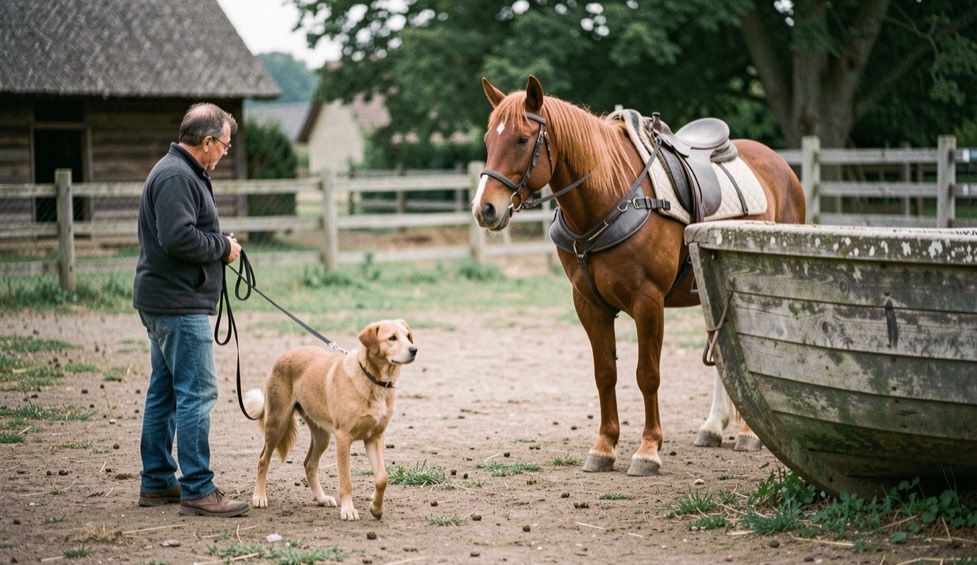
The sequence that produces a calm draft horse is the sequence that produces a calm working dog: ground work before real work, one clear cue for stop, and a load introduced in steps small enough that the animal never has to brace against it. A horse learns to lead, stand and accept the harness before it is asked to move weight. A herding dog learns to walk on a loose lead, stand for handling and hold a stop on a word before it ever meets stock. The two cases differ in one respect that matters to this site: the dog arrives with an eye result in its file, and that result decides how the plan is built.
Why ground work comes before any real work
Ground work is the part of training that never touches the job. For a horse it is leading, standing still, moving the hindquarters away from pressure, and answering voice cues on a long line. For a dog it is the same list in a different body: walking without pulling, standing for examination, giving way to gentle pressure on the shoulder, and coming back to the handler under distraction. None of it looks like work, and all of it is what the work will be built from.
The reason both traditions put ground work first is that a working animal has to accept handling before it can accept a load. A horse that cannot stand while a collar is fitted cannot be trusted between the shafts. A dog that cannot stand while a handler touches its feet cannot be trusted to hold position at a pen gate while sheep move past. The calm, useful responses that handlers want in the field are rehearsed at walking pace, long before anything is at stake.
The field guides published by the Eastern Connecticut field desk for draft horse training guides set out that progression for horses: groundwork for leading, standing and voice cues on long lines, then steady starts and stops, then harness fit and the maintenance of wagons and sleds. The order is not decorative. Each step is the foundation the next one stands on, and skipping ahead is what produces an animal that works in a state of alarm.
Starts and stops are trained, not hoped for
A start and a stop are separate lessons. The horse is taught to take up a load smoothly rather than snatch at it, to stop straight instead of swinging out of line, and to stand and wait after the stop without turning the session into a contest. A dog is taught the same three things on a smaller scale: go out on a line, stop on the word, and hold the stop while the handler walks away and returns.
The criterion is calm, not speed. A dog that drops to the ground instantly and quivers is not offering the behaviour you asked for. A horse that lunges into the collar and then stands blowing is not trained to start. In both cases the correct response is to reduce the difficulty: shorten the distance, lower the distraction, repeat the cue until the response arrives without tension, and only then ask for more.
This is also where the stop becomes a safety cue. A stop that holds at five metres is a convenience. A stop that holds at forty metres, with stock moving and another dog working nearby, is what keeps a herding dog out of a road or away from a machine. That reliability is built in small increments, exactly the way a horse's stop is built up from a few steps on a long line to a full load on a stone boat.
Introducing the load in steps
Nobody hitches a young horse to a loaded wagon on the first day. The weight arrives gradually: a light drag, then a heavier one, then a stone boat, and only then real work, with the handler watching the animal's posture rather than the load. The moment the horse's head comes up, its back hollows or its stride shortens, the session has gone past what it can absorb calmly, and the correct move is to make the task easier rather than to insist.
Dogs are introduced to their version of the load the same way. Stock work starts in a small pen with a handful of quiet animals, not in an open field with a flighty flock. Traffic, machinery noise, gates, ramps and crowds are separate lessons, each introduced below the level that produces alarm. A working dog's first season is deliberately unimpressive: short sessions, easy stock, plenty of standing and waiting, and an end to the session while the dog is still calm.
Handlers who rush this stage usually pay for it later. An animal that has been pushed past its threshold learns to brace, and bracing is the opposite of the loose, responsive way of going that makes heavy work look effortless in a trained team.
Where a CEA result changes the plan
A CEA result does not automatically end a working life, but it does change how ground work, the trained stop and the gradual introduction of a load are planned for a herding breed. Before progressing to carrying weight, owners need to understand what the diagnosis means for the individual dog. The guidance on living with an affected dog sets out prognosis by severity, monitoring for retinal detachment and haemorrhage, environmental adaptations, exercise, disclosure and quality of life, so training decisions can be made with the veterinary team.
Everything above assumes the animal can see the handler. In herding breeds that assumption deserves a check, because Collie Eye Anomaly is common in the population and its effects range from invisible to serious.
A dog whose only finding is choroidal hypoplasia has normal functional vision. The affected choroid sits outside the central visual axis, and these dogs work exactly like clear dogs; I have certified working Rough Collies and Shetland Sheepdogs with mild findings documented at puppy screening. A dog with a small coloboma may carry a small blind spot that it compensates for without anyone noticing. A dog with a large coloboma, or one that has had a retinal detachment, is working with reduced vision, and the training plan has to be rebuilt around that fact rather than around the dog's willingness.
Reduced vision changes how a dog learns, not whether it can learn. Voice cues become the primary channel instead of a supplement. Handling and foot placement are taught by touch. The training area stays familiar, obstacles keep a predictable place, and new ground is introduced on a lead. Many dogs with significant vision loss work happily in scent-based and close-range roles, and the practical adaptations are described in the guide to living with a CEA-affected dog.
The screening that makes this predictable happens early. A puppy eye examination at six to eight weeks, before the pigment changes that mask mild choroidal hypoplasia, plus a DNA test for the NHEJ1 mutation, gives a handler a result that does not change with age. The reasons for that timing, including the go-normal phenomenon, are set out elsewhere on this site. What matters for a working plan is simpler: know the result before the training starts, not after a season of unexplained hesitation.
For dogs with any coloboma finding, I ask for a functional vision assessment before intensive work begins, and I say the same thing to handlers that I say to agility competitors: the assessment is about the dog's real visual performance, not about the label on the certificate. The broader picture of what affected dogs can do in sport and service roles is covered in CEA and working dogs.
The timeline is measured in months
Both traditions are honest about how long this takes. The livestock working dog publication used by 4-H programmes in New England states plainly that a working dog should not be expected to learn its job in a week or a month, and that training is a constant process. The same publication recommends raising the young dog with basic obedience and family socialisation before the strenuous work begins, which is ground work by another name.
The extension guidance behind that publication is worth reading in full: the University of New Hampshire 4-H livestock working dog guide. It covers breed selection, basic training methods and the rules of sheepdog trials, and it treats patience as a working requirement rather than a virtue.
A draft horse follows a comparable curve. Young horses are handled, led and bitted long before they are asked for real work, and the first season under harness is deliberately light. A dog's first year of stock work is the same investment: unglamorous sessions that build a response which will still be there in five years.
Records keep the plan honest
Handlers who work animals for a living tend to keep notes, because memory flatters progress. A training log with dates, session length, the distraction level and what the animal offered is the only way to see that a problem is a bad week rather than a trend. On the veterinary side, the same discipline applies to the dog's health file: the eye certificate, the DNA result, hip and elbow scores, and the dates of each examination.
The draft-horse field desk makes the same distinction in its editorial policy, separating source-backed requirements from practical judgement and naming its limits. That habit transfers directly. A handler should know which parts of a training plan come from a rule, which come from a clinician's assessment of one dog, and which come from a trainer's experience with a hundred dogs.
A sequence you can hold to
- Ground work first: leading, standing, handling, giving to pressure, all at walking pace.
- One stop cue, trained separately from the go cue, and proofed at increasing distance before stock or machinery is added.
- Loads introduced in steps, with the animal's posture as the measure of whether the step was small enough.
- Eye result known before the working season: puppy examination at six to eight weeks, DNA test, and a functional vision assessment for any dog with a coloboma.
- Reduced vision handled by shifting to voice and touch, keeping the training ground predictable, and choosing roles the dog can do well rather than roles it can only attempt.
- Sessions ended while the animal is still calm, and a written log kept of what was asked and what was offered.
None of this is specific to horses or to dogs. It is what working animals have always been taught, and it survives because it produces animals that stay sound and willing for a long career. The dog in front of you brings one extra variable, and it is the one this site exists to explain.
Clinical Summary
Ground work, a trained stop and a gradually introduced load are the common core of draft-horse and working-dog training. For herding breeds, the CEA result belongs in the plan before training starts: choroidal hypoplasia alone does not limit working ability, while colobomas and retinal detachment call for a functional vision assessment and a plan built on voice and touch.
Frequently Asked Questions
Can a dog with CEA work stock?
Dogs whose only finding is choroidal hypoplasia have normal functional vision and work like clear dogs. Dogs with colobomas or a history of retinal detachment may still work, but they need a functional vision assessment and a training plan that leans on voice cues and predictable ground rather than distance vision.
Why does the eye result have to be known before training starts?
Because a handler who does not know the result will read a vision-related hesitation as stubbornness or a training gap, and will push the dog past its threshold. Knowing the result allows the plan to be adapted from the first session, and a puppy examination at six to eight weeks plus a DNA test gives a result that never changes with age.
How long should a working dog's training take?
Longer than most new handlers expect. Extension guidance used by 4-H programmes states that a working dog should not be expected to learn its job in a week or a month, and that training is a constant process. Draft-horse practice follows the same curve, with a deliberately light first season under harness.
What is the first thing to teach?
Ground work: leading without pulling, standing for handling, giving to gentle pressure and holding a stop on a cue. Neither a horse nor a dog should meet its real job before those responses are reliable at walking pace.