
A breeder telephones me, relieved and a little triumphant: the puppy I diagnosed with choroidal hypoplasia at seven weeks now has a perfectly normal-looking fundus at fourteen months, examined by a different ophthalmologist who found nothing. Has the dog outgrown Collie Eye Anomaly? The answer, which disappoints almost everyone who hears it, is no. The dog has "gone normal" — a well-recognised phenomenon in which the visible lesion becomes undetectable on examination while the underlying defect, and the dog's genotype, remain entirely unchanged. Understanding go-normal is one of the most important things a breeder can learn, because it is the single most common reason adult eye examinations underestimate CEA in a population.
What "Go-Normal" Actually Means
The term go-normal describes a dog that showed mild choroidal hypoplasia as a young puppy but whose fundus appears normal on later examination. It does not mean the choroid repaired itself. It means the lesion became invisible to the examiner. The distinction is not academic hair-splitting; it is the entire point. A dog that goes normal is still genetically affected, still carries two copies of the NHEJ1 mutation, and will still pass one copy of that mutation to every single puppy it produces.
Go-normal applies only to choroidal hypoplasia, the mildest expression of CEA. It never applies to colobomas, retinal detachment, or the other severe lesions. A coloboma is a frank absence of tissue and does not vanish with age. When breeders hear that CEA "can disappear," they sometimes extend that hope to severely affected dogs. It does not work that way. Only the subtlest grade of the disease is capable of masking.
Why the Lesion Disappears From View
To understand go-normal you have to understand why choroidal hypoplasia is visible in the first place. In a healthy eye, the retinal pigment epithelium and the choroid sit in dense, pigmented layers that the ophthalmoscope cannot see through. In an affected puppy, the choroid is thin and underdeveloped, so the examiner looks straight through the sparse tissue to the white sclera beneath. That is the classic pale patch we record as choroidal hypoplasia.
As a puppy matures, the retinal pigment epithelium continues to develop and lay down pigment. In dogs with only mild hypoplasia, that maturing pigment eventually becomes dense enough to obscure the thin choroid behind it. The pale window closes — not because the choroid grew, but because the curtain in front of it thickened. The defect is still there; we simply can no longer see it from the front. This is why ophthalmologists describe the dog as having "gone normal" rather than "become normal."
The phenomenon is more pronounced in heavily pigmented dogs and in those whose hypoplasia was borderline to begin with. A dog with extensive, severe hypoplasia has too large a window for pigment to ever fully cover. This is also why go-normal is unpredictable in any individual: it depends on the size of the original lesion and the dog's pigmentation, neither of which we can read off a pedigree.
The Critical Window for Diagnosis
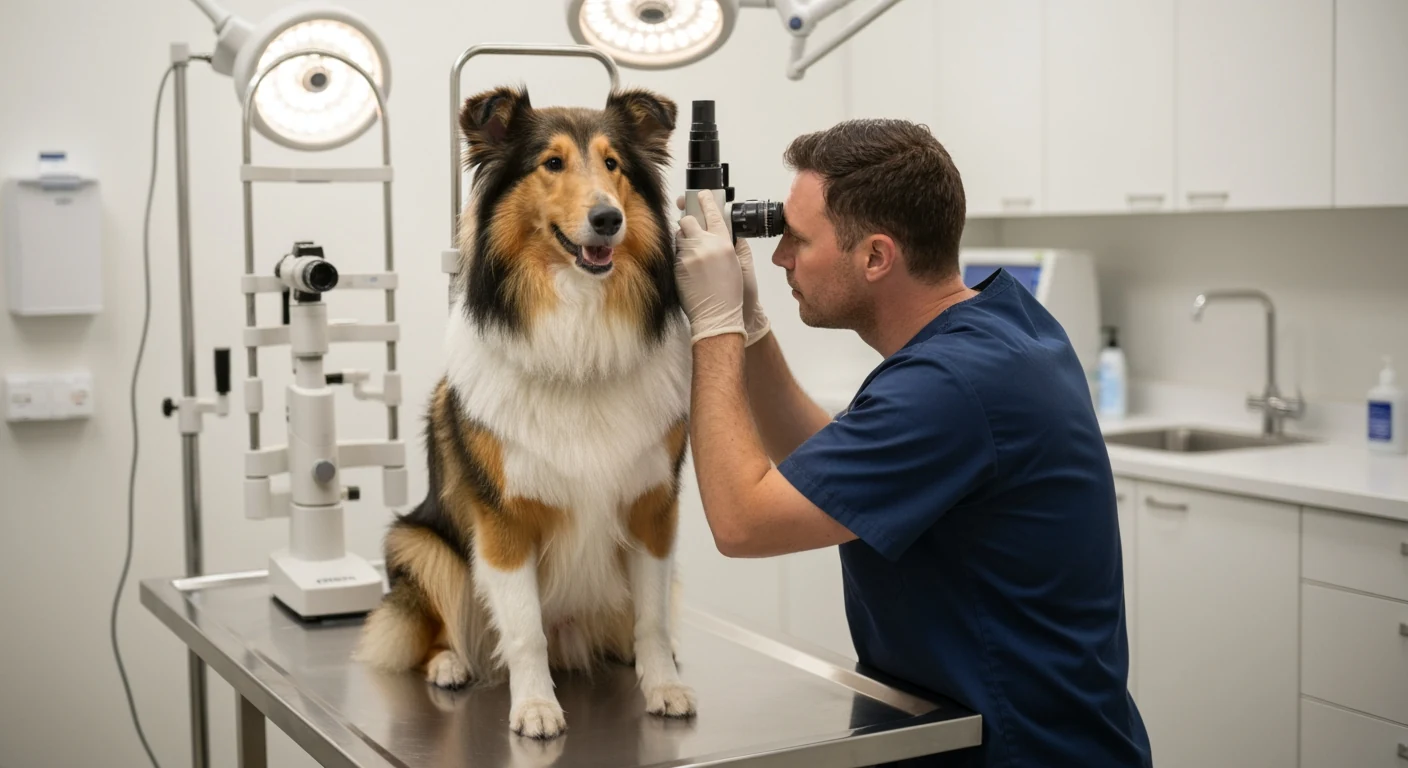
Go-normal is the reason the entire profession insists on examining puppies early. The choroidal hypoplasia is most reliably visible between roughly five and eight weeks of age, before the retinal pigment epithelium has matured enough to obscure the lesion. After about twelve to sixteen weeks, an increasing proportion of mildly affected dogs will already have gone normal, and the examination becomes progressively less able to detect them.
This is the practical engine behind the screening timelines I describe in the guide to CEA diagnosis at different ages. An examination at six to seven weeks captures the truth before the curtain closes. An examination at eighteen months — entirely valid for many other conditions — may simply miss a go-normal dog and record it as clear. The age of the examination is not a detail; it changes what the result actually means.
I cannot count the number of adult dogs presented to me as "eye certified clear" whose litter records, when I track them down, show documented choroidal hypoplasia at the puppy examination. The adult certificate is not wrong about what the examiner saw. It is misleading about what the dog is.
Why Go-Normal Distorts Breeding Decisions
Here is where the phenomenon stops being a curiosity and becomes a genuine threat to breed health. A breeder who relies solely on an adult eye examination, performed after the critical window, may breed a go-normal dog believing it to be genetically clear. Because that dog is actually homozygous affected, it transmits a mutated allele to one hundred per cent of its offspring — not fifty per cent, as a carrier would, but every puppy. Bred to a carrier, such a pairing produces affected puppies at far higher rates than the breeder anticipates from the pedigree alone.
The dog itself is perfectly healthy. Mild choroidal hypoplasia, gone normal or not, almost never affects vision and never progresses. The problem is not the dog's eyesight; it is the silent mislabelling of its genetic status, and the breeding decisions built on that false label.
This is precisely why a clinical examination, however expert, can never be the sole basis for a breeding decision in a CEA breed. The NHEJ1 DNA test reports the genotype directly and is completely indifferent to go-normal. A homozygous affected dog tests affected whether it is six weeks or six years old, whether its fundus looks pale or pristine. Pigment cannot hide a deletion in the DNA. For breeding purposes, the genetic result is the ground truth and the adult ophthalmoscopic finding is, at best, supporting context.
How Modern Imaging Sees Through the Masking
Pigment defeats the ophthalmoscope, but it does not defeat cross-sectional imaging. When I scan a suspected go-normal dog with spectral-domain optical coherence tomography, I can measure the thickness of the choroid directly and almost invariably find it still abnormally thin beneath the matured pigment. The choroidal hypoplasia is demonstrably present; it was never gone. I explain this imaging logic in detail in the article on OCT in CEA diagnosis, where the go-normal question is one of the clearest demonstrations of what the technology adds.
This matters in two situations. First, when an older dog of breeding interest was never examined as a puppy and has no DNA result, OCT can sometimes recover a diagnosis that ophthalmoscopy would miss. Second, when a breeder genuinely cannot reconcile a clear adult certificate with a worrying pedigree, OCT provides an objective measurement rather than a subjective impression. It does not replace DNA testing — only the genetic test reports genotype with certainty — but it is the best tool we have for catching masking on clinical grounds.
What This Means For Owners and Buyers
If you own a dog that went normal, the practical news is genuinely good: your dog's vision is not at risk from mild choroidal hypoplasia, and no treatment or monitoring is needed for the eye itself. There is nothing to fear and nothing to do. The phenomenon only carries weight if you intend to breed, in which case the dog should be treated according to its genotype, not its current appearance.
If you are buying a puppy from a CEA breed, the lesson is to ask for two things rather than one. Ask for the puppy's own eye examination performed within the critical window, and ask for the DNA status of both parents. A breeder who offers only an adult eye certificate on the parents, with no early puppy examination and no genetic testing, may not be hiding anything deliberately — but go-normal means that adult certificate cannot, on its own, tell you what you need to know.
Putting Go-Normal in Perspective
Go-normal is not a loophole or a controversy; it is a predictable consequence of how pigment develops over a mild lesion. The veterinary ophthalmology community has understood it for decades, which is exactly why screening protocols are built around early puppy examinations and why no responsible breeding programme rests on adult clinical findings alone. The phenomenon becomes dangerous only when it is forgotten — when a normal-looking adult fundus is mistaken for a normal genotype.
The clean resolution is the one the profession has already adopted. Examine puppies early, before the window closes. Test DNA to establish genotype with certainty. Treat the genetic result, not the snapshot of the fundus, as the foundation for breeding. Do those three things and go-normal loses all its power to mislead. For a fuller library on screening, grading, and the genetics behind these decisions, the collection of CEA articles ties these threads together.
Frequently Asked Questions
Does a go-normal dog still have CEA?
Yes. A go-normal dog is still genetically affected and still has choroidal hypoplasia. The lesion has only become invisible to the ophthalmoscope because the retinal pigment epithelium matured and now obscures the thin choroid behind it. The defect, and the dog's two copies of the NHEJ1 mutation, are unchanged.
Can severe CEA go normal too?
No. Go-normal applies only to mild choroidal hypoplasia, where maturing pigment can cover a small pale window. Colobomas, retinal detachment, and other severe lesions involve frank absence of tissue and never disappear with age.
Why must CEA puppies be examined before twelve weeks?
Because choroidal hypoplasia is most reliably visible between about five and eight weeks, before pigment matures enough to mask it. After roughly twelve to sixteen weeks, a growing proportion of mildly affected dogs have already gone normal, so a later examination can miss them and wrongly record the dog as clear.
Will a DNA test detect a go-normal dog?
Yes, completely. The NHEJ1 DNA test reports genotype directly and is unaffected by pigmentation or age. A homozygous affected dog tests affected whether its fundus looks pale or perfectly normal, which is why genetic testing — not adult clinical examination alone — should drive breeding decisions.
Clinical Summary
Go-normal is masking, not healing. Mild choroidal hypoplasia becomes invisible as pigment matures, but the dog remains genetically affected and transmits the mutation to all offspring. Examine puppies within the five-to-eight-week window, confirm genotype by DNA test, and base breeding decisions on the genetic result rather than the adult fundus.