
Among the herding breeds where Collie Eye Anomaly has been documented, the Border Collie occupies a distinctive position. Unlike the Rough Collie and Shetland Sheepdog, where affected and carrier rates approaching 70-90% make CEA almost a defining characteristic of the breed, Border Collies have much lower prevalence figures — typically cited at 2-5% of the population. Yet this lower prevalence creates its own challenges for detection and management, and the Border Collie's extraordinary importance as a working dog adds dimensions to the CEA conversation that breeders of companion breeds rarely consider.
Prevalence in Context
The 2-5% prevalence estimate for Border Collies represents a smaller proportion of the breed but still translates to a substantial number of affected individuals given the Border Collie's global population. More importantly, prevalence varies considerably between populations. Studies of working sheepdogs in rural Britain have found lower rates than surveys of registered show-line Border Collies in some national registries, suggesting that different selection pressures over the decades have produced meaningful population differences.
Working sheepdogs — particularly those from traditional hill farming backgrounds where registration and formal health testing have historically been uncommon — may have inadvertently maintained lower CEA frequencies through indirect selection. Dogs with visual problems, even subtle ones, are less effective at distance work and may have been less likely to be selected as breeding stock, creating gentle negative selection pressure against more severely affected dogs. The mild cases likely persisted undetected because, as in other breeds, they cause no functional impairment.
Show-line Border Collies, bred with different selection priorities, do not benefit from this indirect selection and may carry higher CEA rates than working populations. This distinction between working and show lines has implications for testing recommendations and breeding management across different communities of Border Collie enthusiasts.
Clinical Presentation: More Variable Than Rough Collies
When Border Collies are affected by CEA, their clinical presentation tends to be more variable than in Rough Collies. While Rough Collies typically present with mild choroidal hypoplasia, Border Collies have a higher relative proportion of colobomas and more variation in lesion severity. The reason for this is not fully understood but likely relates to the different modifier gene profiles in the two populations — exactly the complex genetic interactions explored in research on modifier genes and CEA severity.
This relative severity bias in Border Collies means that CEA diagnosis in this breed, while less common than in Rough Collies, is less likely to be the benign "nothing to worry about" finding that it so often represents in the Rough Collie context. I examine Border Collie CEA cases with particular attention to coloboma presence and grade, because the implications for vision and complications carry more weight than in the typical Rough Collie presentation.
The full spectrum of CEA severity from mild choroidal hypoplasia through to serious colobomas and potential retinal complications applies to Border Collies as to all affected breeds, but the distribution across that spectrum differs from breed to breed.
Testing in the Working Dog Community
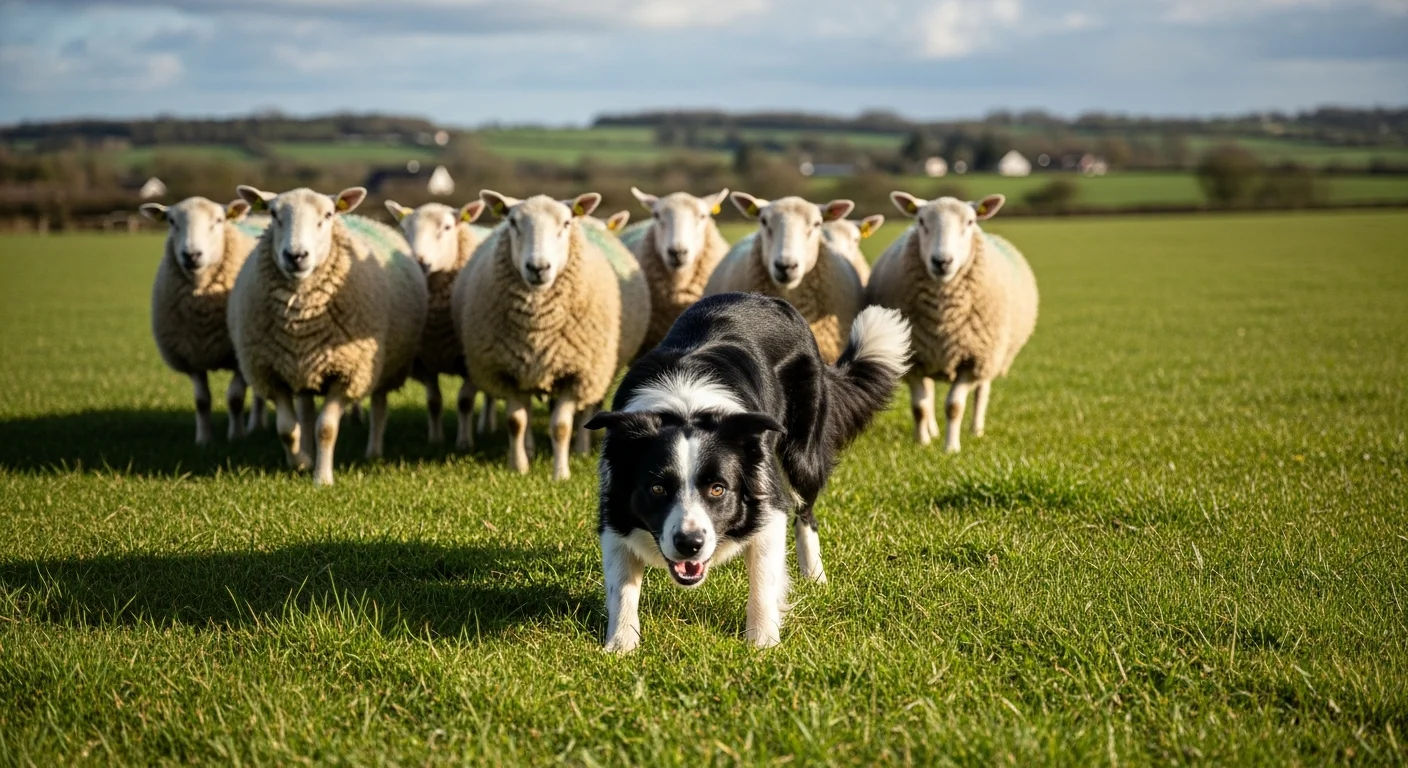
The Border Collie working dog community in Britain, Ireland, Australia, and New Zealand has historically had a more pragmatic approach to genetic health testing than show dog communities. Working dog breeders have often prioritised demonstrated performance over formal health certification, reasoning that dogs selected for outstanding working ability have implicitly passed a practical fitness test.
This approach has merit but does not fully address genetic health. A dog can be an exceptional worker and still carry the CEA mutation, because mild CEA — which represents the majority of cases — creates no functional limitation. The dog's outstanding work performance tells you nothing about its genetic status for CEA or its risk of producing affected offspring.
Cultural change within the working Border Collie community regarding genetic health testing has been gradual but genuine. International Sheepdog Society (ISDS) registered dogs are increasingly expected to have health screening, and the major stud dogs whose genetics shape working Border Collie populations worldwide are now routinely tested by progressive breeders. The movement remains uneven, but the trend is positive.
The Eye Examination in Border Collies
Practical ophthalmoscopic examination of Border Collie litters at the 6-8 week window follows the same principles as in other breeds. The timing requirements are identical — the critical window for accurate puppy examination is the same regardless of breed. What differs is the examination experience: Border Collies are physically active, curious, and often less tractable than more placid herding breeds, which can make examination technically more challenging with very active litters.
I have examined many Border Collie litters over the decades and developed techniques for managing lively puppies without excessive restraint. Brief sedation is occasionally used for particularly difficult examination conditions, though this is uncommon — most puppies at six to eight weeks are manageable with an experienced handler and the right approach.
For adult Border Collies, the same limitations of ophthalmoscopy apply as in all affected breeds. The "go normal" phenomenon means that adult examination alone cannot reliably identify all affected dogs, and genetic testing is essential for complete characterisation of breeding dogs' status.
Bilateral vs Unilateral Presentation
An interesting observation in Border Collies is a slightly higher rate of unilateral or markedly asymmetric presentation compared to Rough Collies, where bilateral symmetric involvement is the norm. I have seen Border Collies with significant coloboma in one eye and only very mild choroidal hypoplasia in the other — a degree of asymmetry that would be unusual in a Rough Collie with comparable genetics.
This asymmetry likely reflects the stochastic element of developmental variation — the same genetic vulnerability playing out differently in the two eyes through random variation in developmental microenvironments. It does not indicate that one eye is "more affected" genetically; both eyes carry the same mutation. But it does mean that each eye must be examined independently, and the grade recorded for each eye separately, rather than assuming the two eyes will tell the same story.
Border Collies and Progressive Retinal Atrophy
Border Collies face a dual inherited eye disease burden, carrying risk not only for CEA but for progressive retinal atrophy (PRA), a separate condition causing progressive vision loss through photoreceptor degeneration. The most common form in Border Collies is rcd4-PRA, caused by a mutation in the C2orf71 gene.
When I examine a Border Collie at any age, I am looking for both CEA-related changes and the early signs of PRA. The conditions are entirely independent — a dog can have CEA, PRA, both, or neither — but differentiating them requires careful ophthalmoscopic examination. Early PRA changes can sometimes be confused with the peripheral fundus changes of CEA by examiners without extensive experience in both conditions.
Responsible Border Collie breeders should test for both conditions. The testing approach described on this site for CEA is complementary to PRA testing — the same DNA sample can be screened for multiple conditions simultaneously, making comprehensive health testing economical and convenient. The progressive retinal atrophy resource provides detailed guidance on PRA in affected breeds including Border Collies.
Advice for Border Collie Breeders
Given the lower prevalence of CEA in Border Collies compared to other affected breeds, some breeders question whether testing is justified. My view is that the moderate prevalence of 2-5% is more than sufficient to justify testing breeding stock. With modern panel testing, adding CEA to a PRA and MDR1 panel costs little additional investment per dog and provides complete information about the dog's genetic status for all major herding breed conditions simultaneously.
Specifically for Border Collies, I recommend:
- Puppy ophthalmoscopic examination at 6-8 weeks for all litters from untested parents
- Genetic testing of all breeding dogs before first mating
- If parents are both genetically clear, litter examination can be simplified (though some breeders choose to examine regardless for documentation purposes)
- Annual retinal examination for breeding dogs to screen for PRA as well as monitoring CEA stability in known affected dogs
- Testing of influential stud dogs shared widely within working dog communities, with results made publicly available
The breeding strategy principles are the same as for all affected breeds. The breeding strategies to reduce CEA incidence work for Border Collies as for Rough Collies — use genetic status to inform matings, never produce affected puppies unnecessarily, but do not exclude genetically valuable dogs simply because they carry the mutation.
International Variations
Border Collie populations vary considerably between countries in both CEA prevalence and testing culture. Australian and New Zealand working dog populations, which have historically been more isolated from European show lines and have used different selection criteria for many generations, have their own particular genetic profiles. Studies from these populations are limited compared to the extensive UK and North American data, but the available evidence suggests CEA is present though perhaps at somewhat different rates.
European working Border Collie populations that have maintained close connections to British working lines through imported stud dogs may show CEA prevalence closer to British figures. The international data on breeding programme outcomes for CEA demonstrates that coordinated testing and mating management can genuinely reduce disease frequency — lessons applicable to Border Collie breeders worldwide.